

News
Tribal Environmental Resiliency Resources Act
On April 2, 2024, the Tribal Environmental Resiliency Resources Act (TERRA Act) was officially introduced in the U.S. House of Representatives as H.R. 7859 during a pro forma session. The bill was referred to the House Natural Resources Committee.
Alaska Native Health Board (ANHB) commends the introduction of the Tribal Environmental Resiliency Resources Act (TERRA). The health and wellness of Tribal communities is intrinsically tied to the environment. As the statewide voice on Alaska Native health, ANHB acutely understands how climate change disproportionately affects Alaska Tribes, many of which are already facing the extreme scenario of relocating their communities. The TERRA Act fills essential gaps by providing a way to coordinate these complex community driven relocation projects, as well as other Tribal climate resiliency efforts at all levels, while centering Tribal self-determination. ANHB calls on Congress to prioritize these urgent concerns and pass the TERRA Act to support the environmental resiliency of all Alaska Native and American Indian people.
ANHB Releases White Paper on Ongoing Barriers to Access Water and Sanitation in Rural Alaska
ANHB’s Water and Sanitation Committee has released a White Paper, entitled “Ongoing Barriers to Access Water and Sanitation in Rural Alaska”, to highlight continued barriers to achieving access to water and sanitation systems in our unserved and underserved rural Alaska communities.
Executive Summary
Piped water prevents disease and unnecessary suffering, and saves money and lives. Health disparities in rural Alaska persist due to lack of piped water systems. The Infrastructure Investment and Jobs Act provided $3.5 billion to the Indian Health Service (IHS) for sanitation facilities construction for Alaska Native and American Indians, but the projects in rural Alaska still require cost contributions for the costs to serve public facilities. The State of Alaska is in a position now to support these projects through its Village Safe Water (VSW) Program, yet several barriers exist for rural Alaska communities to access this funding. Operation and Maintenance Best Practices scores and Sustainability Plan requirements prevent communities from accessing VSW Program funds, which are required to match federal funds from USDA and EPA. The result of these barriers is that our rural Alaska, predominately Alaska Native communities will miss the opportunity to leverage VSW funds to fully serve communities. We should act now to take advantage of the opportunity the IIJA offers to provide lifesaving water and sanitation in rural Alaska.
You can read the full White Paper by following this link.
ANHB Partners with the National Indian Health Board, Tribes, Organizations, and Friends of Indian Health and Worked Together in Joint Letters to Congress
On March 3, 2022, the Alaska Native Health Board joined the National Indian Health Board along with 72 Tribes, Organizations, and friends of Indian health that represent well over 1 million American Indian, Alaska Natives, and friends of Indian health joined to urge Congress to include advance appropriations and request no less than the House of Representatives passed level of $8.114 billion for FY 2022 funding for Indian health care. The letters were sent to the following House of Representatives and Senate Committees:
- House Committee on Appropriations and Appropriations Subcommittee on Interior
- House Committee on Natural Resources and Subcommittee for the Indigenous Peoples of the United States
- House Native American Caucus
- Speaker of the House and House Minority Leader
- Senate Committee on Appropriations and Appropriations Subcommittee on Interior
- Senate Committee on Indian Affairs
- Senate Majority Leader and Senate Minority Leader
The current continuing resolution expires on this Friday, March 11, 2022. Congress is negotiating and finalizing an omnibus appropriations bill to fund the federal government through the end of FY2022 which ends on September 30, 2022. If passed, that level of funding would be an increase of $1.884 billion over the FY2021 enacted level and Indian health programs would be protected against the harmful impacts of continuing resolutions (temporary funding measures) and government shutdowns.
Alaska Legislature Honors Alaska Native Health Board
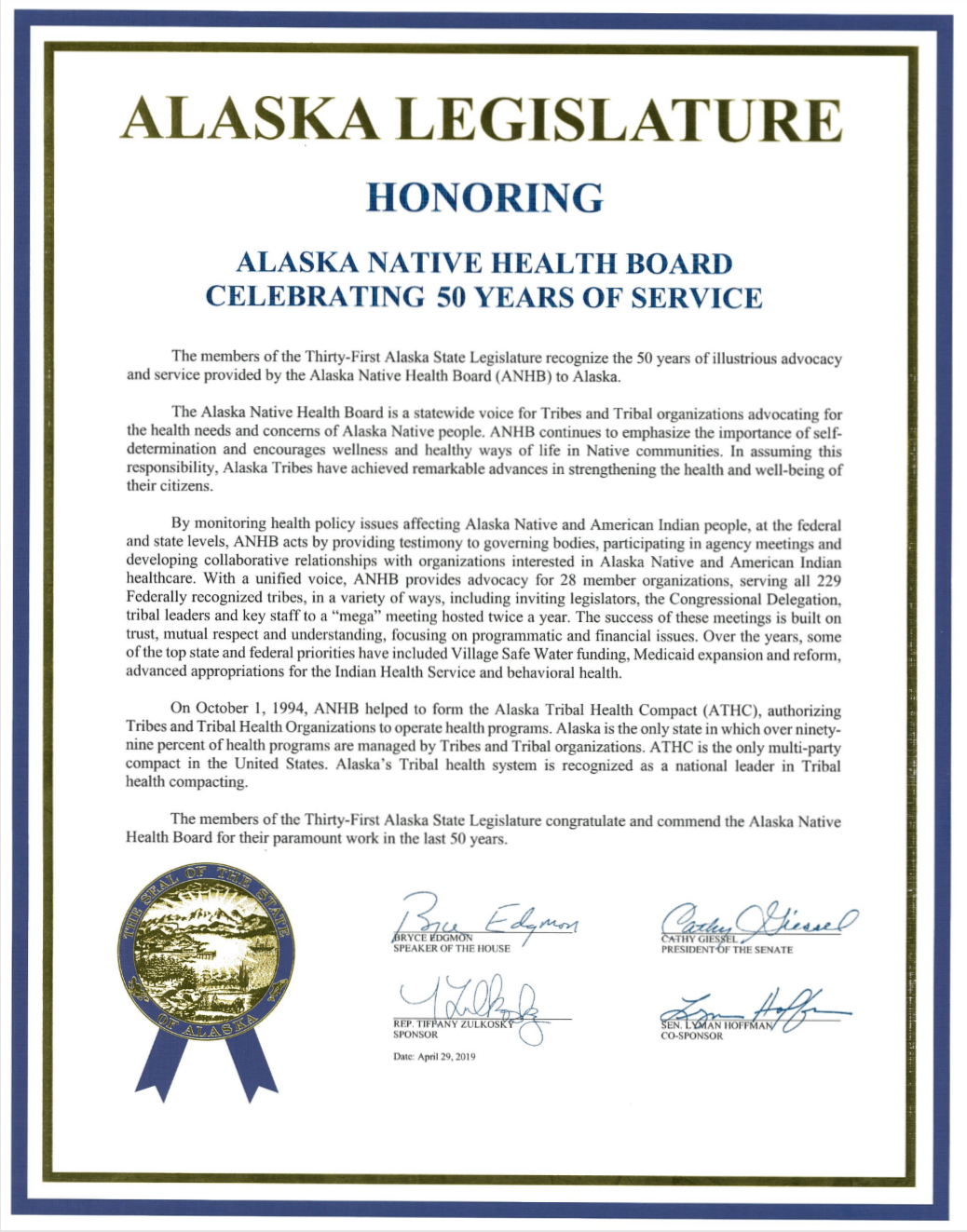
The Alaska State Legislature recognize the 50 years of illustrious advocacy and service provided by the Alaska Native Health Board to Alaska.
PRESS RELEASE: ANHB Hires New President/CEO
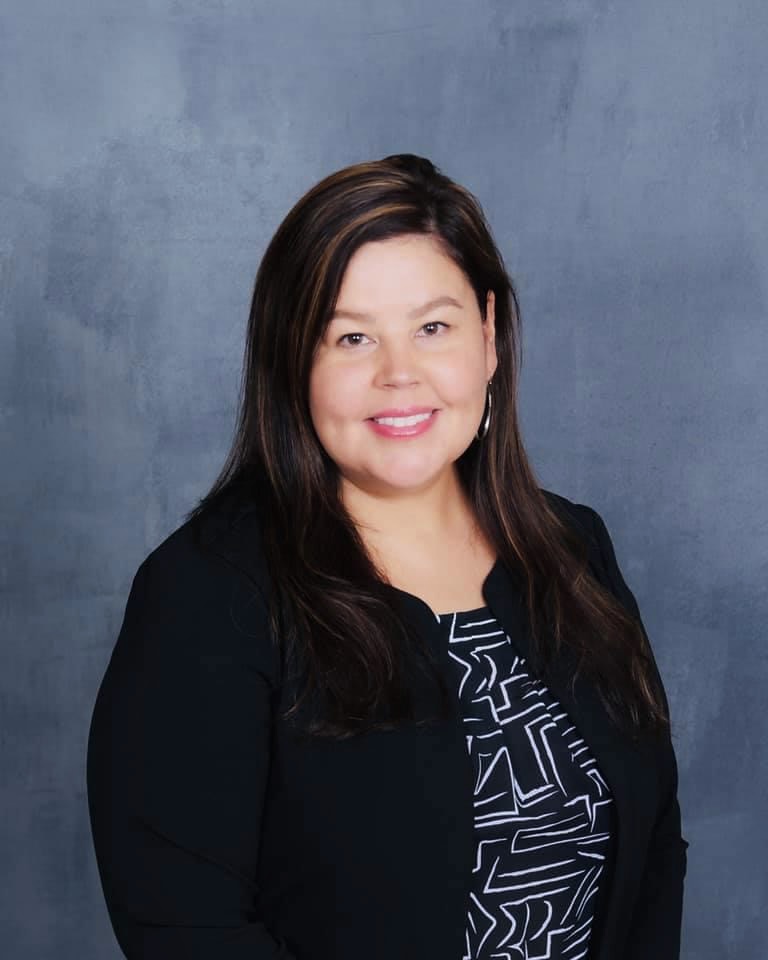
FOR IMMEDIATE RELEASE
September 3, 2021
ALASKA NATIVE HEALTH BOARD
ANNOUNCES NEW PRESIDENT AND CHIEF EXECUTIVE OFFICER
Anchorage, Alaska – The Alaska Native Health Board (ANHB) Board of Directors and Executive Committee selected Chief Operating Officer Alberta (Aakaq) Unok as the organization’s next President and Chief Executive Officer. In her new position, Alberta will oversee the day-to-day management and operations of the organization.
Over her ten years with ANHB, Alberta has been a successful member of the executive leadership team, facilitating statewide meetings and advocating for Tribal health needs. Alberta, who joined ANHB in 2011 and most recently served as Chief Operating Officer bringing experience with advocacy and program development to the position. In 2016, she was the recipient of the National Impact Award from the National Indian Health Board. Before joining ANHB, she was the lead program administrator in the development of the federally-recognized Behavioral Health Aide Program for the Alaska Native Tribal Health Consortium.
“We are grateful for Alberta’s experience with ANHB and steadfast dedication to our organization,” said Andrew Jimmie, ANHB Board of Directors Chairman. “The Board chose Alberta for her ability to continue fostering a culture of respect and improvement while moving forward with strategic priorities and advocacy for the Alaska Tribal Health System.”
Originally from Kotlik, Alberta is Yup’ik, a shareholder of Calista Corporation and a Tribal citizen of the Village of Kotlik. She holds a Bachelor of Science and Master of Business Administration from Alaska Pacific University. She is active in the community and currently serves as the technical advisor for the Department of Health and Human Services Secretary’s Tribal Advisory Committee and Indian Health Service Tribal Self-Governance Advisory Committee. She has dedicated her work to fostering constructive communication with government agencies, elected officials, industry stakeholders and fellow advocacy organizations to raise awareness of Tribal health issues by promoting meaningful dialogue on strategies for effective policy changes at the state and federal levels.
On accepting the position, Ms. Unok shared, “I am so honored to be granted this opportunity to continue to work with Tribal representatives from across the state and ANHB’s partners. I believe whole heartedly in the strength of the Alaska Tribal Health System and ANHB’s advocacy efforts.”
Founded in 1968, ANHB is a private, statewide, nonprofit organization with a mission to promote the spiritual, physical, mental, social and cultural well-being and pride of Alaska Native people. ANHB is the voice of the Alaska Tribal Health System.
###
Guide to Exchanging COVID-19 Health Information
The Alaska Native Health Board has worked with our partners to develop a “Guide to Exchanging COVID-19 Health Information” to help support the safety, security, and public health of Alaska Native communities and patients. This guide collects information and guidance issued by the U.S. Department of Health and Human Services on how to apply the Health Insurance Portability & Accountability Act (HIPAA), as amended, to better help Tribal communities understand applications of the HIPAA Privacy Rule in a public health context.
Attachment Links:
https://www.hhs.gov/sites/default/files/hipaa-and-covid-19-limited-hipaa-waiver-bulletin-508.pdf
Alaska Native Health Board Announces RFP for Audit Services
The Alaska Native Health Board (ANHB) is placing this Request For Proposal (RFP) for the preparation of its yearly audited financial statements and related filings for a three-year period beginning with the 2023 fiscal year and ending with the 2025 fiscal year. Our organization does not require a federal single audit. The audit of ANHB’s financial statements must be performed in accordance with generally accepted auditing standards.
Background
ANHB was established in 1968 and incorporated as a nonprofit 501(c)(3) organization under Alaska State Law in 1976. ANHB serves as the statewide voice on Alaska Native health issues. ANHB is a 28-member representing tribes and tribal organizations carrying out health services on behalf of the 229 federally recognized Tribes in Alaska, and works on behalf of over 177,000 Alaska Native People; additionally, as a critical component of the Alaska Public Health System, the Alaska Tribal Health System serves thousands of Non-Alaska Native People. As the statewide tribal health advocacy organization, ANHB assists tribal partners, state and federal agencies with achieving effective communication and consultation with tribes and their tribal health programs. ANHB’s objectives are to enlighten and give the public a better understanding of the matter and problems of health affecting Alaska Natives. The mission of ANHB is to promote the spiritual, physical, mental, social, cultural well-being, and pride of Alaska Native people. The primary funding sources for the organization are membership dues, special events, and private grants and contracts.
ANHB’s financial statements are presented on the accrual basis of accounting in accordance with accounting principles generally accepted in the United State of America.
The financial statement presentation follows the recommendations of the Financial Accounting Standards Board (FASB) in its Accounting Standards Codification (ASC) 958, Financial Statements of Not-for-Profit Organizations. Under ASC 958, ANHB is required to report information regarding its financial position and activities according to three classes of net assets: unrestricted net assets, temporarily restricted net assets, and permanently restricted net assets.
Further information and a Scope of Work can be found in the attached RFP document.
Tentative Timeline
- ANHB 2023 Fiscal Year End – September 30, 2023
- RFP release – Friday, October 6, 2023
- Submitting RFP Questions Deadline – Friday, October 20, 2023, 3:00 p.m.
- RFP Submission Date – Friday, November 3, 2023, 11:59 p.m. AKDT.
- Evaluation, Interview and Selection Period – November 3, 2023 – November 17, 2023
- Tentative Award Date – Monday, November 20, 2023
- Tentative Audit Office/Virtual Site Visit – Week of December 4, 2023
- ANHB 2023 Annual Financials Completed – February 1, 2024
Additional information for this RFP is available in the attached document.
ANHB Releases Novel Coronavirus Response White Papers
The Alaska Native Health Board, in an effort to help inform lawmakers and policymakers, has been developing a series of white papers that touch on the impacts, preparedness, capacity, and difficulties facing the Alaska Tribal Health System and Alaska Natives during the Novel Coronavirus Response and Crisis of 2020.
Currently in this series:
- COVID-19 and Alaska Native Communities
- Coronavirus Public Health Response to Alaska Fisheries in Rural Alaska Native Communities
As the impacts and response to Novel Coronavirus continue to evolve, the Alaska Native Health Board will work to present the most up-to-date and relevant information affecting Alaska’s Tribal Health System and its Native peoples.
Updated 5/13/2020
National Tribal Budget Formulation Workgroup FY2022 IHS Budget Recommendations
The National Tribal Budget Formulation Workgroup has finalized their recommendations for the Indian Health Service Fiscal Year 2022 Budget. Below is a copy of those recommendations. A link to the full document is here.
ANHB Testifies Before Congress in Support of Advance Appropriations
ANHB President and CEO, Verné Boerner, provided testimony to Congress on September 25, 2019. The Legislative Hearing, entitled Advance Appropriations: Protecting Tribal Communities from the Effects of a Government Shutdown, was before the House Committee on Natural Resources, Subcommittee for Indigenous Peoples of the United States. Ms. Boerner was one of many Tribal leaders who discussed the impacts that government shutdowns have on Tribal operations and patient care, highlighting the positive impacts that advance appropriations authority would give to Indian health programs.
The hearing focused on two pieces of legislation introduced during the 116th Congress. The first was H.R. 1128, the Indian Programs Advance Appropriations Act, introduced by Congresswoman Betty McCollum. H.R. 1128 seeks to authorize advance appropriations for the Bureau of Indian Affairs, the Bureau of Indian Education, and the Indian Health Services. The second bill was H.R. 1135, the Indian Health Service Advance Appropriations Act, introduced by Congressman Don Young. H.R. 1135 seeks to provide advance appropriations authority only to the Indian Health Service. Congressman Young has introduce similar bills in the 113th, 114th, and 115th Congresses and has been a long-time advocate of advance appropriations authority for the Indian Health Service.
Each of the House bills also now has a Senate companion legislation. On September 25, 2019, Senator Lisa Murkowski’s Office introduce a companion bill to H.R. 1135, S. 2541. The bill was introduced with Senators Tom Udall (D-NM) and Dan Sullivan (R-AK) as original co-sponsors. The companion legislation to H.R. 1128 is S. 229, introduced by Senator Udall’s Office. Currently, the entire Alaska Congressional delegation supports Indian Health Service advance appropriations authority.
Below is a copy of Ms. Boerner’s testimony.
Video of the Subcommittee Hearing.


